Friday, June 27, 2014

Summer Cycling (or, dealing with the heat without getting burned.)

Disclaimer: I make no claims to expertise, nor make claims to safety, on these topics.  Exposure to the elements, hot or cold, can be harmful on their own, let alone when mixed with exercise.  If you have questions or medical concerns, your first stop should be your primary care physician and not Google (or this blog) for your answers.


The days are longer, and the temperatures are warmer, means that it's a time when people start looking to get in bigger rides.  It's also important to know about how to deal with the issues that the warmer temperatures bring.  I cannot think of a single person that wants to end their riding season because of injury - this should include issues such as dehydration and heat stress.   Since my background is not medical, my focus is not as much to inform you of the actions you should take, but rather to hopefully get you thinking about the various things that you need to do individual research on and make thoughtful decisions.   


Acclimation -

 Here in South Carolina, the temperatures can change rather rapidly during the early summer months.  It was just 2 weeks ago that I was participating in the Ride 4 Animal care, and my Garmin recorded a cool 70°F during the climb up Green River Cove.  Just last weekend on another training ride, that same device recorded a sweltering 100°F peak temperature.  That extreme of a difference in temperature in just a week is highly uncommon, but as the Summer months get into full swing, it takes our bodies time to acclimate to the new weather patterns.  According to the Encyclopedia of Sport Science, it can take up to 14 days for your body to acclimate to warmer temperatures.  Mackenzie Madision wrote for  US Triathlon with several suggestions and guidelines for heat acclimation.

Sun Exposure -

While Sun exposure is something to think about during all times of the year, the summer months is when the Sun hits folks in the Northern Hemisphere more directly.  Thus if you are planning big rides, taking care of your skin should be vitally important.  While crisp tan lines are often lauded, crisp burn lines are painful and hazardous.  Make sure to read the instructions on your sunscreen, and follow them correctly.  Just because the SPF rating is 35 doesn't mean you have all day protection if you put it on at 6 in the morning;  some sunscreens may not let your skin properly breathe, and may make your warmer during exercise. Many of the modern sunscreens soak in after just 2 hours, leaving the protection under your skin (instead of on it). If you are looking for resources on which sunscreens work the best,  there are plenty of websites that spend hours digesting all of the data out there.  The Environmental Working Group has plenty of resources on sunscreen and its effectiveness, for example.  Kitchen Stewardship even goes so far as to review various sunscreens and offer up home made alternatives to the chemical soups sold in stores.  

I have also increased my intake of Omega 3 fatty acids (Fish Oil) and Vitamin C during the Summer months to help stave off sunburns.  While no supplement regimen can claim medical advice, I've gone from perennially red to being able to handle long bike rides in the sun. 

Hydration -

I've saved the most talked about of the 3 until last.  From expensive sports drink commercials to every website dealing with exercise, hydration is almost always at the top of the list of things that folks concentrate on.  During the warm Summer months, the facts are that you are going to sweat more.  After you are acclimated to the heat your body is going to sweat sooner, and harder, although your sweat may have a lower electrolyte (salt) count.  Waiting until you are thirsty to try to fill back up your reserves is not going to be effective over any length of workout.  Getting (and staying) hydrated before and during an effort is critical not only for a good workout, but for staying out of trouble.  Losing just 2% of your body weight from sweat loss can greatly impact your results.  The American College of Sports Medicine recommends the following guidelines for staying hydrated:

Before exercise
  • Goal: Start exercise properly hydrated
  • Drink 16-20 fluid ounces of water or sports beverage at least four hours before exercise
  • Drink another 8-12 fluid ounces of water 10-15 minutes before exercise
During exercise
  • Goal: Prevent a >2% loss in body weight
  • Drink 3-8 fluid ounces of a sports beverage (5-8 percent carbohydrate with electrolytes) every 15-20 minutes when exercising greater than 60 mins
  • Do not drink more than one quart/hour during exercise (32 fluid ounces)
After exercise
  • Goal: Fully replace fluid and electrolyte deficits
  • Drink 20-24 fluid ounces of water or sports beverage for every one pound lost

While there is no guaranteed solution for how to handle being out in the elements, making wise informed decisions is the key to success.  Spend the time to inform yourself of the conditions that you are going to be exposed to during your event, and make sure to account for them in your plan.  Just like in fueling in general, waiting until you "need it" will put yourself into a hole that is nearly impossible to dig yourself out of.   

Thursday, June 19, 2014

2014 Ride 4 Animal Care

For the second year, TeamFS has sponsored a charity ride to benefit Animal Care, a Greenville County rescue organization that helps find pets new forever homes.  Several friends and I learned last year that this is a very challenging ride, even on the shorter 40 mile route, but a chance to ride up one of my favorite climbs in the upstate gives me reason to come back each year.


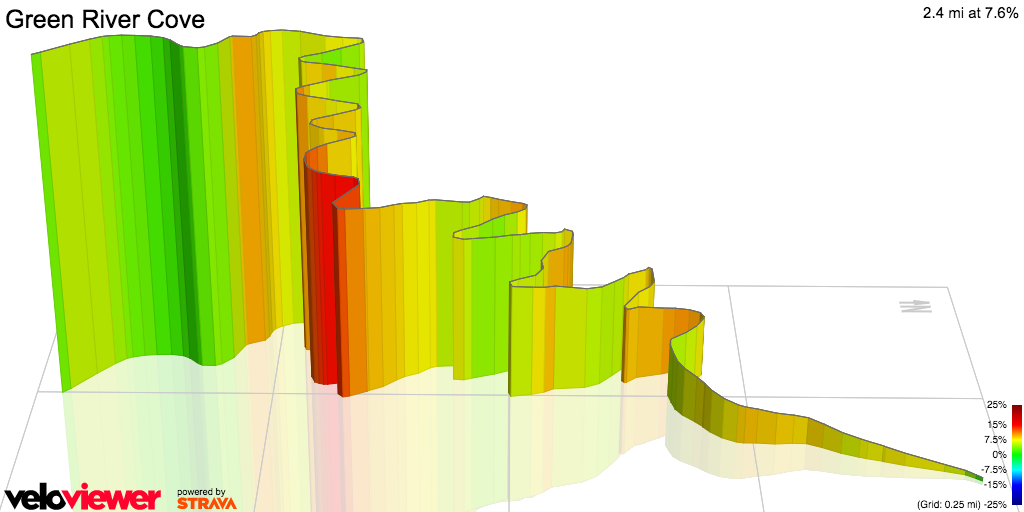
The Ride 4 Animal Care has several good climbing sections, but the main feature is a chance to climb Green River Cove.  SteepClimbs.com describes Green River Cove as "[o]ne of the toughest climbs of the area is covered by trees and has 17 tight switchbacks. "   While the climb is much shorter than some of the other local riding attractions, this one is quite well known for those 17 switchbacks.  During the summer months it can be even more challenging because the Green River is a popular tubing and kayaking spot in the upstate as well.


rendering of Green River Cove from VeloViewer.com

Before you can experience Green River Cove, you have to get there.  The ride started at the North Greenville University stadium in Tigerville, SC.  Last year we had an early climb up Callahan Mountain, but because of construction work earlier in the week, the route was changed to bypass that climb and go out Dividng Waters road toward the Greenville Watershed. Most of the riders doing the 40 and 60 mile routes were not upset over this change, as we had plenty of climbing to experience without the extra from Callahan.
At the start time the temperatures were in the mid-60's, although we all knew that this wouldn't last through the day.  As we climbed up the Greenville watershed, the sun was just starting to peek through the treelines, making for some terrific views.


views on the watershed in the morning
Once through Saluda the group I was with worked up to the rest stop where the 40 mile route split from the 60 mile route, and took a break.  One of the big things that I'm still working on with these bigger rides is taking enough of a break to recover before attempting to move on.  Once I get on the bike, I get into a zone where I really don't want to stop.  Getting a rest and recovery is vital, though.  Once I had a banana and some rest time, it was off to head down Holbert's Cove.

Holbert's cove is probably one of the most technical and challenging long stretches of road that I have ridden.  The terrain mixes in hard rollers, with gradients over 15% and hard turns.  It also affords some picturesque views that are sometimes hard to take in an enjoy.


The most technical area of Holbert's Cove is about 3/4 of the way down from Saluda, and is a rather sharp right hand turn.  I've only encountered this turn twice, the first time being during a training ride for the Assault on Mt Mitchell in 2013.  I was already aware of how technical this turn is, and that you have to be careful of your speed as you approach it.  I got myself overly concerned about speed, and didn't get prepared for making the turn, so I overshot it, but was able to correct before heading off into the trees.  I felt very lucky that there were no oncoming cars as I got myself back onto my side of the road as quickly as possible.


Once past Holbert's Cove, you get into the long stretch of mostly flat riding that follows the Green River, knowing that at the end of this stretch is the moster that is known as Green River Cove.  You pass by the river cabins, kayaking locations, and tube rental camps, all set in a rustic setting.  The river looks calm and inviting, and you can see the mountains all around you.  The temperatures in the cove had yet to break 70 degrees, so the wind felt nice.  It leads you into a false sense of security with how serene it is. 


Once you pass over the Green River for the final time, the climbing starts.  With 17 switchbacks, measuring your efforts becomes critical.  The best part for me is that these switchbacks have numbers on each turn, giving me something to focus on during the climb.  Knowing how much of an effort is left allows me to dig deeper to keep going when you really just want to stop and take a long nap.  At the top of the climb is a short ride back to the rest stop in Saluda.  It was a welcome break, and one that I made sure to actually time to make sure I rested well enough before continuing on the route.  With 20 miles left to go, I didn't want to rush through this stop and regret it later in the ride.  After having a banana and refreshing both water bottles, I was on my way.

The last 20 miles of the ride follows the same route as the 40 mile version, going down the Saluda Grade and back up Fork Creek road.  The Saluda Grade is named for the section of road that follows the steepest segment of standard grade railroad line in the United States.  The road has wide sweeping turns, and is a fun section to ride down.  The climb up Fork Creek Road isn't very technical or steep, but with recent road work was a little hazardous in dealing with gravel in the road.  Near the middle of this section there is a fork in the road, and looking at the conditions I chose to take the slightly longer route that had less visible gravel.  I was quite glad that we were traveling up this section, instead of riding down it.  


The final segement of the ride was a trip back down the watershed, and then riding back to Tigerville.  The route takes you past George Hincapie's new resort, Hotel Domistique, finishing up on Chinquapin Road.  It happens that my family was working the rest station that was located in the parking lot of the Hotel, so I made one final stop to fill up water bottles and say hello before riding back in.  

Totally 67 miles and almost 6000' of climbing, the Ride 4 Animal Care is definitely a challenging route, and one that I look forward to riding again next year.  Each year Vince and the TeamFS folks are learning how to improve the event, and I'm sure it will be even more spectacular next year.  Personally I hope that they decide to add event numbers, as they are great souvenirs, if not having an optional medal that can be given to people that complete the full 67mi event.

Thursday, June 5, 2014

Avoiding Derailments

This is going to be a bit of a "double entendre" post, although the message really is the same for me. With just over 6 weeks left before the Ride to Remember, it's important for me to remember that the goal is not to just "go fast", but I'm preparing for a big effort in an event situation. This means being smart about my training and avoid unneeded injury. At this point I'm not going to make any major jumps in fitness before RtR. I have to listen to my body, and not necessarily push through pain. While Jens Voigt is famously known for the saying "Shut up Legs", I need mine to tell me where I am. Last month I took on a large increase in volume, as part of testing where I was fitness-wise for the Ride to Remember. My time in the saddle, as well as my mileage, ballooned well beyond what I had been doing previously this year. While I'm glad that I was able to complete several challenges, a first for me on Strava, it also came with a lot of risks. My knees already are a weak spot for me. By pushing myself above my previous training volume, I risked aggrevating old injuries on my patellar tendons. Typically it just means tendonitis, and being uncomfortable while riding for longer distances, or doing a lot of climbing. As a precaution, I'm following the "R.I.C.E." strategy (Rest, Ice, Compression, Elevation), minus compression. Stretching and quality time with my foam roller to keep everything limber will be on the schedule as well. I have two events this month that I'm intending to do (Ride 4 Animal Care, Bee Buzzin' Bicycle Tour), along with one last super long training ride scheduled for the end of the month.


Approaching SRT tracks

The other side of not derailling my efforts is making smart decisions on the bike. This means not taking unnecessary risks, especially around railroad tracks. I learned the hard way late last year that tracks are not something to toy with. I was lucky that my injuries were minor, and I was able to ride away. If you talk to folks that have been riding for a while, a majority have stories to tell about railroad tracks. Works like "fracture" or "crack" are often used in combination with "clavical or hip". Just this spring I've had multiple friends end up off the bike for extended periods of time while their injuries heal. These are folks with tens of thousands of miles on the bike; I've riden with them on events like the Assault on Mt Mitchell. These aren't novice riders that didn't know how to handle tracks. 


After my encounter, I felt like I had just been body slammed by a professional wrestler. One moment I was crossing the tracks, the next I was picking myself off the ground. There wasn't a moment of "I'm going to fall" or "oh this is going to hurt". Anything that happened between when my wheel caught the rail and I went down was done purely on instinct. I had to have landed on my right arm, as it was tender for several weeks afterwards. If I had more time, I probably would have had worse injuries, as I probably would have attempted to put my arm out to brace myself.


After my tumble I take a lot different attitude towards tracks: unless I'm confident that I have a good angle to cross (close to, if not, perpendicular), and the conditions are good, I'll unclip and cross with one foot on the ground. Folks probably think I'm out of my mind when I reach the tracks on the Swamp Rabbit, but I unclip every time I cross those. The angle is poor, and the spacers are wooden (and thus have a chance to be rotten). The honest truth is this - I've been on an almost constant training routine for almost 3 years now, between just getting into shape and preparing for various rides. I don't need to take the risk that today is the day that the tracks are a little bit slippery, or my judgement is off on what angle is going to get my wheels safely over the gaps. No Strava segment, or draft advantage in a group ride, is worth being sidelined waiting for bones to mend.

Monday, May 19, 2014

16hours, 250mi, 5 days

With 2 months left to go before the Ride to Remember, I've been refocusing my efforts on making sure that I can complete and enjoy the 3 day trip.  With back to back to back days of riding across South Carolina, it's going to be a completely different level of challenge to what I've trained for in the past.  For rides like the Assault on  Mt Mitchell, the effort is contained in a single day.  The concept I used was the train to be prepared for that one huge day of effort, and then take 2 or 3 days off afterwards to recover.  Now I need to be able to put out large efforts multiple days in a row, conserving and refueling appropriately to be able to complete mile 250 over 48 hours after I start mile 1.

Thus when I saw that Strava had a riding challenge sponsored by Scratch Labs that was designed to be done as a multi-day effort, I figured it was a good opportunity to test out my current fitness level prior to the Ride to Remember.  The Scratch Labs Stage Race Challenge was set around the 8 days of the Amgen Tour of California, and required you to log 16 hours of moving time during the event.  Doing some quick napkin math, I realized that if I averaged at least 15 miles per hour during the time period, I would also end up riding a cumulative total of miles as I would experience on the Ride to Remember.  It was going to take efforts every day to finish with enough time (and miles) logged.


Monday - with the first day lost to a mechanical issue, I decided that I needed to ride on what is typically a rest day for me.  With my new Garmin 800 in hand, I decided to try out a different route than I typically take.  It would give me a chance to learn more about the bike computer, and give me some time on the bike.  The ride was very successful, and I logged in my first solid ride of the week.  2 hours down, 14 to go.


Tuesday - looking ahead on weather sites indicated that I was going to have to compensate for at least 1 rain day during the week, which meant figuring out when I could get in more and/or longer rides.  With a 20% chance of rain Tuesday afternoon, I had to make the decision to ride at lunch to make sure I got in time, or decide to risk riding in the afternoon.  What I decided to do was make it a potential "2 a day" scenario:  get in an easy ride during lunch, and if the weather held out go out again to SCTAC for additional time/mileage in an easier group than I'm used to.  The lunch ride went without a hitch, and I let my cycling clothes dry during the afternoon in preparation for the evening ride.


Evening came around, and the weather looked favorable.  After a ride around the SCTAC airport known as the "Perimeter Road Loop", I went out with the 16mph group.  I just wanted to sit in and have a somewhat easy ride, although very early on I could tell that the group wasn't going to end up being a pace that I'd really enjoy.  Thus about a quarter of the way out I decided to go out on my own ahead of the main group, and bridged over to another group ahead of us.  With Tuesday in the books, I was at 6 hours and 92mi completed.


Wednesday - originally on Monday when I decided to ride, I scheduled this to be a recovery ride day, knowing that Tuesday evening was probably going to be difficult.  When the forecast started showing an extremely high chance of rain on Thursday, I knew I had to move up my timetables and use Thursday as an off the bike recovery day, just in case of bad weather.  Thus instead of just a single extremely easy ride, I ended up completing yet another "2 a day" workout.  Ride #1 was another 30mi long loop, using the same route that I had taken Monday.  


The evening ride ended up being the original intended recovery ride.  At this point I had to say that my legs were extremely tired, but I was happy about my ability to set an effort level and keep to it given additional efforts ahead.  At the halfway point of the week I was just under the 10 hour mark.  The goal was in sight!


Thursday - the weatherman didn't disappoint.  With rain pretty much all day, many of the group rides were canceled.  I kept looking at the after work forecasts to determine if there was a glimmer of hope of getting in a quick ride, but the wet roads and radar reports didn't make it look very promising.  By about 7pm the roads were looking relatively clear, but the sky still looked threatening.  I wasn't too concerned with 3 days of riding left that I could get the time in.  

Friday - I had already been figuring out what I wanted to do for rides over the weekend, and I came across an older 80mi route that I had been really wanting to try out all spring.  Looking at the forecast, it was going to be cool but nice, and it would give me over 4 hours of time in the saddle.  For the ride on Friday what it meant was that I had to make sure to get in time Friday, but definitely not overdo it.  While longer than the recovery ride Thursday evening, it was a shorter effort than I had been doing most lunchtimes thus far.  I was now just over 4 hours left to finish the challenge, with a big 80mi ride the next day!


Saturday - I have to say that building up an epic week of riding like this has a way of really testing if you are able to stick to your game plan, as well as keep each workout within reason so you can maintain your effort.  With a seemingly monsterous route ahead of me, especially solo, it was going to be a good dry run of my ability to keep to my game plan.  Without the distractions of keeping with a group, it was up to me to make good sound choices on fueling and pace.  After a good breakfast, and a little bit of a late start, I got underway.  I ended up needing arm warmers, as the weather was cooler than expected at the start of the ride, and I packed enough water and food for at least 2/3 of the ride.  I already knew in my head that I'd probably be stretching that to be for the entire ride, but I had made this route with at least 2 known good rest stops along the way.  Of the 80 miles that I was going to ride, there was probably only about 10 or 15 miles of it that were new roads to me.   That meant that at any point I could decide to change the route up if I felt that things were not going well.


During the route I did extremely well at making sure to have fuel, and taking my time when I needed to.  The hardest parts to deal with really were the climbs.  Up until this week, the largest effort week I had done was 171miles and 11 hours.  This meant that by Satuday I was into uncharted territory for how much energy I'd have left.  I was having to make sure to conserve energy whenever possible, allowing myself the chance to recover on downhills and setting an easy pace on the uphills.  The goal wasn't to set any personal records, but rather to get a solid effort in and have good time in the saddle.  

What I wasn't expecting was that the weather was going to show signs of turning.  The weather reports had said a 30% chance of rain on Sunday, and clouds in the afternoon Saturday.  By the time I was just about home on the route, the winds started to pick up, and if I was back Florida I would have expected a severe thunderstorm within the hour.  I worked my way back to the house, and completed the course in just over 5 hours of moving time.  16 hours completed, and 252miles traveled.  This turned out to be a good strategy, as Sunday ended up being washed out all day long.  The weather finally cleared late in the afternoon.  For me it ended up being a great afternoon to catch up on some rest and spend some time with the family.

In the end I feel like my training is in a good place as the time draws nearer for the Ride to Remember.  My goal for the ride isn't to go with the A group and ride like crazy each day, but rather to enjoy the experience and ride with friends and teammates.  The ride profile should work well to my personality type on the bike, as the majority of the non-flat riding ends up being late on Day 1 and early on Day 2.  As long as I am able to "ride my ride" during the event, and force myself to stop when I know it's appropriate, I should do fine.


Friday, May 16, 2014

Hiatus

It wasn't my intention to take an almost 3 month break from posting.  It's not that I haven't been out riding, or had anything to write about, but after a few weeks of missing out on writing about a topic, I felt like I was behind, and it snowballed from there.


AOTC 2014 did not disappoint


So, in my worst announcer type voice, here is the short-short version of the past 3 months:  I've gone through several highs and lows and completed the Assault on the Carolinas, which was once again a fantastic ride.  I've dealt with another wave of mechanical issues on the bike, including being managing to taco my small chainring, and had to make the decision to drop from riding in the inaugural Beech Mountain Metric.


Even my Garmin had a mechanical... Taco... small ring.

At this point I've set my sights, training, and fundraising on the Ride to Remember this July.  It'll be the first 3-day event that I have ever attempted, and it encompasses over 240mi of riding.  The fundraising benefits the Alzheimer's Association, where the funds raised are used to help Alzheimer's research, care, and support of the over 5 million Americans suffering from Alzheimer's currently.

Personal life also required more attention during the past few months, and I've had several lower than average volume weeks as a result.  With only 9 weeks left until the Ride to Remember, though, I feel like I'm on track.  In fact, I'm looking forward to giving a recap of the Skratch Labs Stage Race Challenge on Strava which I'm using as a dry run of what to expect in July.  With only 6 hours of riding left to complete the challenge, I feel like it is really putting me to the test.

Monday, February 24, 2014

Mountain Training

Oh, these vast, calm, measureless mountain days, inciting at once to work and rest! Days in whose light everything seems equally divine, opening a thousand windows to show us God. Nevermore, however weary, should one faint by the way who gains the blessings of one mountain day; whatever his fate, long life, short life, stormy or calm, he is rich forever.  - John Muir
Just a week ago we were facing record-setting amounts of snow and ice in the upstate, and trainer rides were the name of the game.  Getting out for a ride once the temperatures warmed up was a nice "change of pace", even if it was a windy and you still had to be on the lookout for remnants of ice.  


Hard to believe that this was less than 2 weeks ago


The wonderful thing about winter in the upstate is that snow melts quickly, and the ice and snow gives way to clear skies and dry roads.  Saturday the forecast was for highs in the 60's.  Time for some climb training in the mountains!  Up until now most of my training this year has been focused on trainer sessions and hill repeats at best, so I wasn't really sure what my legs were going to give me.  In fact, just two days before on my training plan I was doing 3 minute hill climbs up the back side of Paris Mountain.  A big personal goal for me this year is to train "smarter" by keeping to training plans, instead of just blasting away miles and pushing myself in haphazardly before events.  Since I've signed up for the Beech Mountain Metric this May, I need to keep myself focused on steady amounts of climbing.  

The route that was established brought us up one of the more favorite climbing spots in the upstate:  The Greenville Watershed.  This route is a gradual continual climb, and you can chose to go to Saluda or Tuxedo.  We started in Tigerville SC, a popular starting point for groups on any given clear Saturday.  In fact, as I parked at the meet-up spot I noticed the cars of several friends I typically ride with who obviously were already out enjoying the day.  We started out by climbing up Callahan Mountain, which is a notoriously steep climb, averaging around 9% grade for about 1 mile.  On the way down towards the watershed we stopped at the Poinsett Bridge and took a few pictures.  Created in 1820, it's one of the oldest bridges in South Carolina. 


Poinsett Bridge

Upon reaching "the Watershed" we met up with several groups of cyclists out for their day in the mountains.  While some were heading to Saluda, many were heading up to Tuxedo today. The Assault on Mount Mitchell training rides were even heading this direction today.  We kept the pace on the easy side, as our goal wasn't to set any personal records but rather to get in good training miles.  Regrouping at the top, we then turned off onto Mount Olivett.

This is another popular climbing area, although this is the first time that I had a chance to attempt it.  While not as long as the Watershed (3.6mi vs 6.4mi) the average grade for this section is steeper (6% vs 4%).  Adding on Mt Olivett to the climb was definitely a great test of the legs this early in the season.  What I was really pleased about was that I was able to climb it at a relatively relaxed pace, and not feel like I had to kill myself just to stay upright.  The view at the top was definitely worth the time climbing up.


Views like this never disappoint
At the top of the climb we intersected with Pinnacle Mountain Road, and made the turn to descend back to Flat Rock for our Bakery stop.  The trip down was much more technical than the climb, and I was glad to have upgraded brakes.  While this wasn't as exciting as coming down Skyuka Mountain Road, it definitely was challenging, especially at the bottom.  With no major incidents descending, we moved on to the most important part of the ride:  The Bakery!

While getting a chance to ride in the mountains is reward enough, there is something to be said about getting to stop at the local bakeries.  The stop for today was the Flat Rock Village Bakery, where we enjoyed a snack and some time off the bike to relax.  With a snack, a pit stop, and fresh water in our bottles, we were ready to head back.  The trip back was a straight shot down 225/old-US25 to the Watershed.  At the bottom we decided to go past Hotel Domestique, owned by retired pro cyclist George Hincapie.  This also adds another few shots of climbing which is always a little bit cruel, since you end up descending for  long enough to let your legs cool down prior to getting to these hills. 

What I was very pleased about for this ride was the ability to ride in a comfort zone, keeping a consistent effort for more than 3 hours in the saddle.  I'm so used to trying to "keep up" that I end up spending an entire ride in harsh heartrate zones.  Having an endurance/tempo pace was refreshing.  While I still need to work on more effective fuel strategies for both during and after the ride, keeping myself in check is important.  As I look towards the Spring, I think I'm going to be in a good place to be strong and have a lot of fun without worrying about getting dropped.


Tuesday, February 11, 2014

The best laid plans

As a part of 2014, I realized that I had to do something different than 2013 to meet the goals that I had laid before me.  For 2013 my big goals were to complete the Assault on Mt Mitchell and to ride at least 400mi/month on average (but aim for 100mi/week average).  I completed all of these goals, riding over 5,400 miles and completing the Assault as my first English Century.  What I realized is that without a comprehensive training plan, I was expending a lot more work than I should have needed to in order to complete the first of these goals, and by having goals that were distance-based I was setting myself up for always feeling like I had to be on the road gathering miles.  I signed up for 3 "major" events for 2014, which I will consider my "hard goals", and I'm working on the "soft goals" for additional requirements along the way.  The events that I've signed up for at this point are:

  • The Assault on the Carolinas - 62mi ride in the early spring that was one of my favorites from last year.  Starts and ends in Brevard, NC and benefits the Rotary in Transylvania County.
AOTC 2013 finish line

  • Beech Mountain Metric - this is a new event for 2014, and is a metric century event in Beech Mountain, NC.  Starts and ends at ~1mi above sea level, this is going to be a challenging climbing event.
  • The Ride to Remember - this is a 3 day event where riders travel from Simpsonville to Charleston, SC.  Proceeds from this ride benefit the Alzheimer's Association. The lengths increase from 60mi to 80mi and culminating with a 100mi ride to the coast.  240mi in 3 days will be a real challenge, and will test my ability to recover and prepare.  This is also a fundraising event, so I will be working on creative ways to gather support for the ride.

Beyond the planned events, I have a few other goals I would like to cover in the process.  


  • Complete a training plan -  This one sounds easy enough, but sticking to a 10-12 week plan is very challenging.  It means finding a way to ride when riding is the last thing you want to do.  It will mean NOT riding when I should be resting, and preparing myself mentally and physically for the rest of the year.  So far I am working my way through a training plan using Training Peaks right now that will finish right before the Assault on the Carolinas.  It is going to be very challenging, but I think it will ultimately be very beneficial.
    Feb 3-9 training log.

  • Quality over Quantity - Instead of just putting in miles all the time, I'm focused on my rides having a purpose.  If this means spending an hour with The Sufferfest to get a workout to target certain aspects, or just following the training plan, giving my workouts a purpose should allow me to do more with less time on the bike.  
  • Balance Bike & Family time - last year to meet my mileage based goals I ended up riding on both Saturday and Sunday ... a LOT.  This meant taking time away from my duties as a husband and father.  This year I am looking to balance that out, making sure to not rush out on the bike when I don't need to, and getting my other goals accomplished around the house.  I'm hopeful that this can extend to finding a way for the whole family to spend time on the bike together as well.
Taking a Water Break

    With focused goals that are within my own ability to control and manage, I think 2014 will be another good year on the bike.